TNOU MCA 2026: Eligibility, Fee, Duration and Syllabus
Tamil Nadu Open University (TNOU) offers Master of Computer Applications (MCA) and MCA (Lateral Entry) programmes under a non-semester pattern. Admissions for the Academic Year 2026–27 are open online through 13 October 2026. Final-year students complete an 8-credit project work (MCA-26) evaluated out of 200 marks.
Key facts
| Programme Name | Master of Computer Applications (MCA) |
|---|---|
| Study Pattern | Non-Semester |
| Project Course Code | MCA-26 (8 Credits) |
| Project Evaluation Fee | Rs 500 |
| AY 2026–27 Admission Last Date | 13 October 2026 |
| TEE Aug 2026 Project Submission Deadline | 23 October 2026 |

MCA Programme Overview and Structure
TNOU offers MCA and MCA Lateral Entry [MCA(LE)] programmes under a non-semester delivery pattern through distance learning, managed by the School of Computer Science.
TNOU has not published explicit general eligibility rules or complete tuition fee breakdowns for the MCA degree on its portal as of 03 October 2026. However, third-year theory examination rules and project evaluation fees are specified in university regulations.
MCA Course Curriculum and Practical Labs
The MCA syllabus covers hardware fundamentals, system architecture, programming in C and UNIX, data structures, and software engineering. Practical learning is structured across five core lab subjects.
- Hardware Concepts and CPU Organization: Logic gates, memory organization, ALU, register transfer, microinstructions, and microprogrammed control units.
- Microprocessor Architecture and Parallel Processing: Motorola 68000 microprocessor, assembly language, RISC/CISC architectures, pipelining, and vector processing.
- Programming Concepts and UNIX: Process management, CPU scheduling, file permissions, Shell programming, and system administration.
- C Programming and Data Structures: Pointers, structures, stacks, queues, linked lists, graph traversals, AVL-trees, B-trees, and sorting techniques.
- Systems Analysis and Design: SDLC, feasibility studies, DFDs, data dictionaries, decision trees, and HIPO diagrams.
- Lab 1: Programming in C with Data Structure
- Lab 2: Object Oriented Programming Using C++
- Lab 3: Internet Programming and Graphics
- Lab 4: Visual Programming and Accounting Package
- Lab 5: Relational Database Management Systems
Final Year MCA Project Guidelines (MCA-26)
Final-year MCA students must complete a mandatory project work (Course Code: MCA-26) carrying 8 credits. The project report must not exceed 100 pages typed in Times New Roman 12-point font with 1.5 line spacing, submitted in an A4 bound volume.
- Project Guides: Eligible guides include TNOU School of Computer Science faculty, Computer Science faculty in affiliated colleges of recognized Indian universities, or qualified TNOU Academic Counselors. A supervisor can guide a maximum of 5 students per session.
- Academic Year Deadline: Project reports submitted before June 30th have results declared alongside June Term-End Examinations.
- Calendar Year Deadline: Project reports submitted before December 31st have results declared alongside December Term-End Examinations.
- TEE August 2026 Session: Students appearing for Term-End Examination August 2026 must submit their project on or before 23 October 2026.
MCA Project Evaluation and Fee Scheme
| Component | Maximum Marks | Minimum Passing Marks |
|---|---|---|
| Project Report Evaluation | 150 | 75 (50%) |
| Viva-Voce Examination | 50 | 25 (50%) |
| Total Project Assessment | 200 | 100 (50%) |
| Project Evaluation Fee | Rs 500 (paid with 3rd-year exam fee) | N/A |
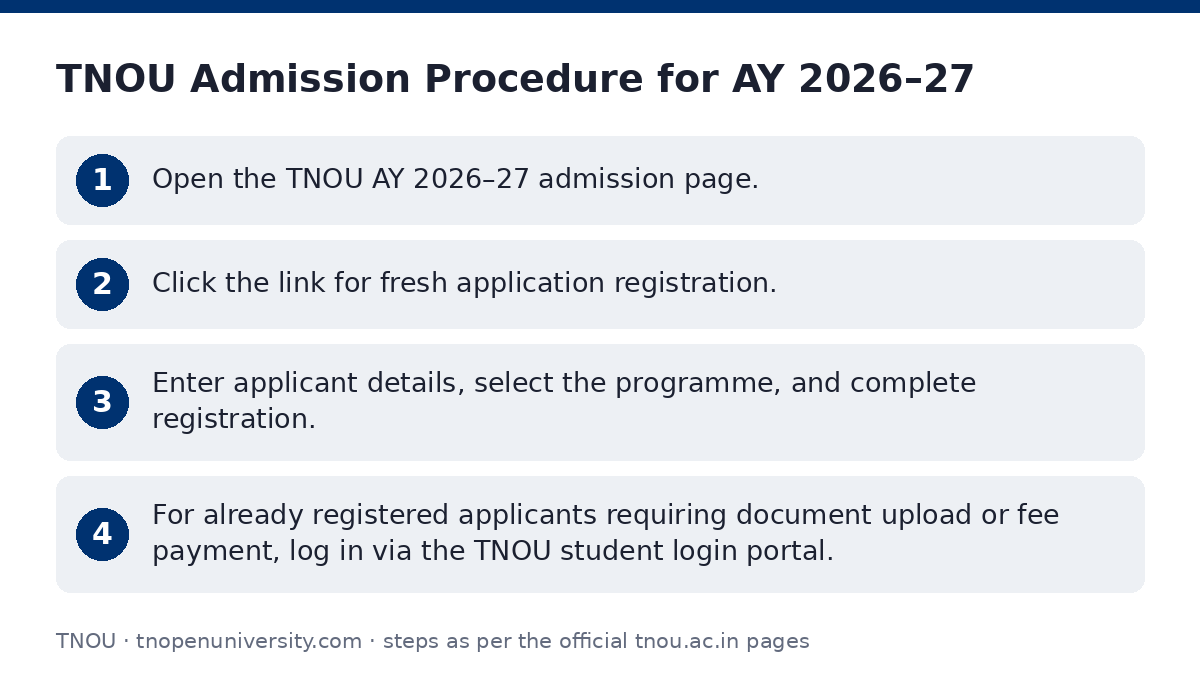
TNOU Admission Procedure for AY 2026–27
Online admission for the Academic Year 2026–27 session is conducted via the university portal. The extended last date for online registration is 13 October 2026.
- Open the TNOU AY 2026–27 admission page.
- Click the link for fresh application registration.
- Enter applicant details, select the programme, and complete registration.
- For already registered applicants requiring document upload or fee payment, log in via the TNOU student login portal.
Important TNOU links
| What you can do | Official page |
|---|---|
| Register for AY 2026-27 online admission | tnouportal.in/OnlineadmissionHomeAY2026.aspx |
| Check prospectus updates and fee details | tnou.ac.in/ProspectusNew.php |
| Upload documents or pay student fees | tnouportal.in/ |
Official documents (PDF)
- MCA & MCA(LE) Non-Semester PDF — MCA and MCA LE syllabus and learning outcomes
- MCA/M.SC Project Guidelines PDF — MCA final year project submission guidelines and evaluation rules
Frequently asked questions
What is the pattern of the TNOU MCA programme?
The TNOU Master of Computer Applications (MCA) and MCA Lateral Entry programmes are offered under a non-semester pattern.
What are the passing marks for the MCA project work (MCA-26)?
Students must score a minimum of 50% in both components: 75 out of 150 marks in report evaluation and 25 out of 50 marks in the viva-voce examination, totaling at least 100 out of 200 marks.
How much is the MCA project evaluation fee at TNOU?
Final-year MCA students must pay a Project Evaluation Fee of Rs 500 along with their third-year theory examination fees.
What is the last date for AY 2026–27 online admission at TNOU?
The last date for online admission for the Academic Year 2026–27 session has been extended up to 13 October 2026.
When is the project submission deadline for the TEE August 2026 session?
Students appearing for the Term-End Examination August 2026 must submit their MCA project reports on or before 23 October 2026.
Who is eligible to guide TNOU MCA project work?
Projects can be guided by TNOU Computer Science faculty, faculty from affiliated Indian college computer science departments, or approved TNOU academic counselors. Each guide can supervise up to 5 students per session.
Has TNOU published the full MCA tuition fee structure for 2026?
TNOU has not published the complete general tuition fee schedule for MCA on its site as of 03 October 2026, though project evaluation fees are fixed at Rs 500.
Sources
Written from the official TNOU pages and documents below, as read on 3 October 2026.
- MCA_TNOU-converted.pdf tnou.ac.in/…/MCA_TNOU-converted.pdf
- Online Admission tnouportal.in/…/OnlineadmissionHomeAY2026.aspx
- School of Social Sciences tnou.ac.in/…/SchoolSocial.php
- MCA & MCA(LE) Non-Semester tnou.ac.in/…/MCA.pdf
- MCA/M.SC Project Guidelines tnou.ac.in/…/MCA-MSC-Project-Guidelines.pdf